Chapter 5: Song
A life is probably held up by just a few words.
- 玄心 (Fuheng Wu)
University
Senior year at Jianyang High School was either problem sets or exams—
day in, day out.
It felt more and more pointless.
Luckily, it was finally ending.
When we had to list our preferred universities on the form,
only then did I discover
there were so many universities in China.
I had no idea which to pick.
I asked the girl in the front row, the one who was good at math,
whether she would aim for the two hardest schools.
She said that sounded boring—
better to go to Agricultural University—
and herd sheep and have fun.
I said then all I could do was go to Forestry University
and plant trees.
Later,
my father said he'd once been a Red Guard
and on a train to Beijing for the "link-up" treks of those years,21
he'd met a student from a famous university
who'd given him a long talk about revolution and impressed him deeply.
He told me to choose that school.
So I did.
When the college entrance exam came,
I didn't place as zhuangyuan again—not as I had in my first year of high school.
The zhuangyuan—
was someone we had never heard of.
Later,
he and I were admitted to the same university.
It was in Beijing, a famous engineering university.
On the train to Beijing,
someone offered me a seat.
He said a student from a top university came.
I declined his kindness—
after all, the trip took twenty hours or so.
That year, "three" kept appearing.
The department I entered was the third department,
my student ID was three to the third power
and in the dorm I was third by age.
Our major took three students from Sichuan.
I happened to be the third.
It felt like fate.
The campus was huge—
a soccer field and a swimming pool.
The dorm room was spacious.
Six of us didn't feel cramped.
No fans, but there was a television.
I had come alone, but the other students
all had parents with them—
some even brought relatives.
The classmates from the north spoke beautiful Mandarin.
The northeastern accent sounded like a comedy skit from CCTV's Spring Festival Gala.
My Sichuan accent, one classmate said, sounded like a cartoon dub.
My classmates were talented—
some excelled at soccer,
some at the pipa.
Some loved to tell jokes.
There was a guy from Shandong—
the tallest in our class.
He earned a perfect score in chemistry on the college entrance exam.
When he introduced himself,
he said his only real gift was being tall—
he didn't have much else to offer.
Some classmates also brought specialties from home:
dried milk curd from Inner Mongolia,
jackfruit from Hainan—
things I never even heard of before.
At night in our dorm-room talks,
we traded stories about our hometowns,
the strange and gifted people from high school
and sometimes the girls in our class
or the good-looking guys in the class next door.
Sometimes I had already fallen asleep but the conversation was still going.
Once,
a roommate from Liaoning and I got into an argument over the short i sound in English.
I said you should open your mouth less, more like ee.
He said open it wider, closer to ay.
Neither of us would give in.
Later, another roommate told us we were both right.
One was British English.
The other was American.
That's when it hit us:
there was more than one kind of English.
Little by little, we learned from one another
and the distance quietly faded.
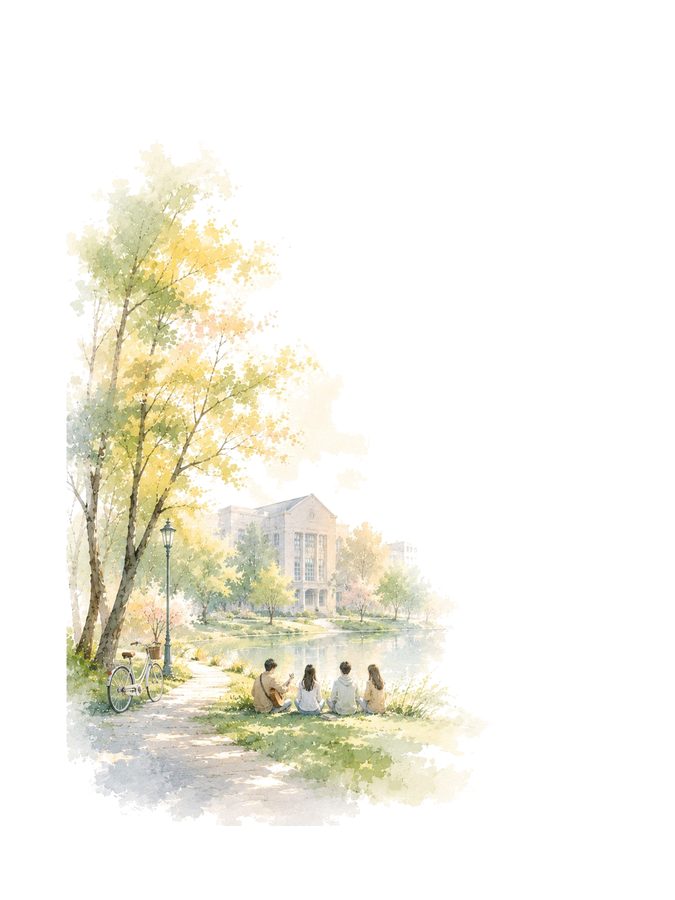
That autumn was the most beautiful season on campus.
At university I still studied hard.
I rarely went out for fun.
To this day I still haven't even been to the Great Wall.
But I began slowly to open up.
Life wasn't only textbooks.
I also wrote characters.
Drew.
Played guitar.
And sang.
On weekends I would even go to Renmin University
look up a high school classmate, watch films and drink beer,
make friends, and talk big about economics
and sociology I didn't understand.
Back then I felt that if you could still do things like that,
life wasn't so bad.