Chapter 1: Mountain
Because it's there.
- George Mallory
Spring
I was born in the mountains.
The village was small—
no more than a dozen households.
Most people shared the same surname: He.
Our house sat halfway up the slope,
nestled against the mountain.
In summer,
ridge after ridge stretched into the distance,
endless.
In winter,
clouds drifted slowly through the valley,
spreading all the way to the horizon.
Sometimes,
I could still see sunlight on the clouds,
while below, it was raining.
I often wondered
what it would feel like to lie on those clouds.
I was a person with land.
My mother said
there was a field at the foot of the mountain that was allocated to me.
In spring we planted rice seedlings.
In autumn we harvested the rice.
My father carried it home on his shoulder pole.
Higher up the mountain we had land too,
where we grew cotton.
I picked the cotton bolls and carried them back home.
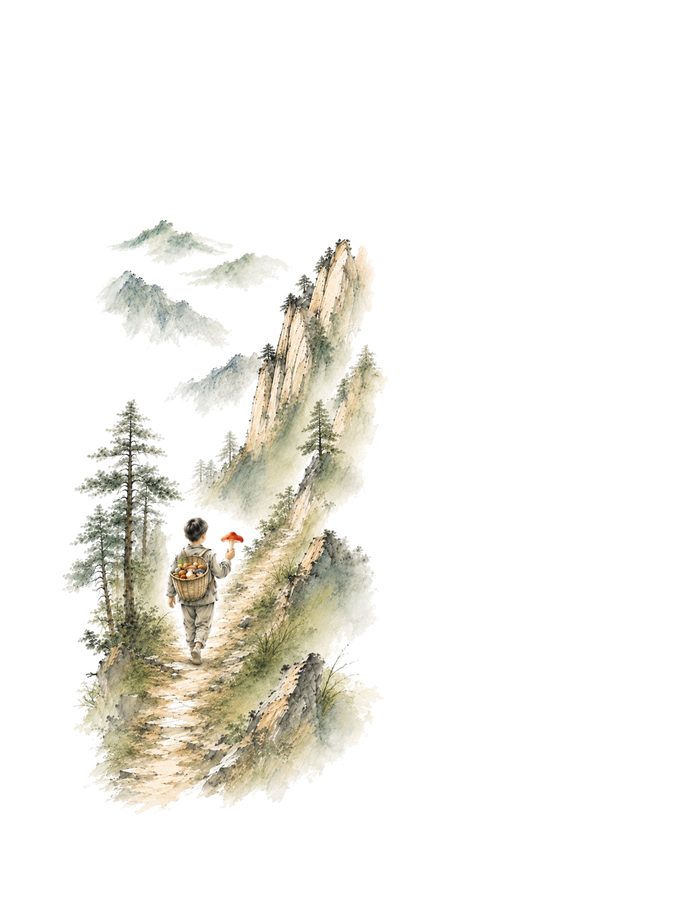
Sometimes I found mushrooms along the way.
I was very good at picking mushrooms.
I knew where mushrooms grew
and which kinds were safe to eat.
Once,
the rain came down hard.
After it cleared,
I went to pick mushrooms.
In the sky there was a bright sphere, big as a wok lid.
I thought it was the sun.
It drifted back and forth,
came toward me,
then turned toward the slope below.
After one deafening crack,
that "sun" was gone.
Back then I didn't know it was ball lightning.
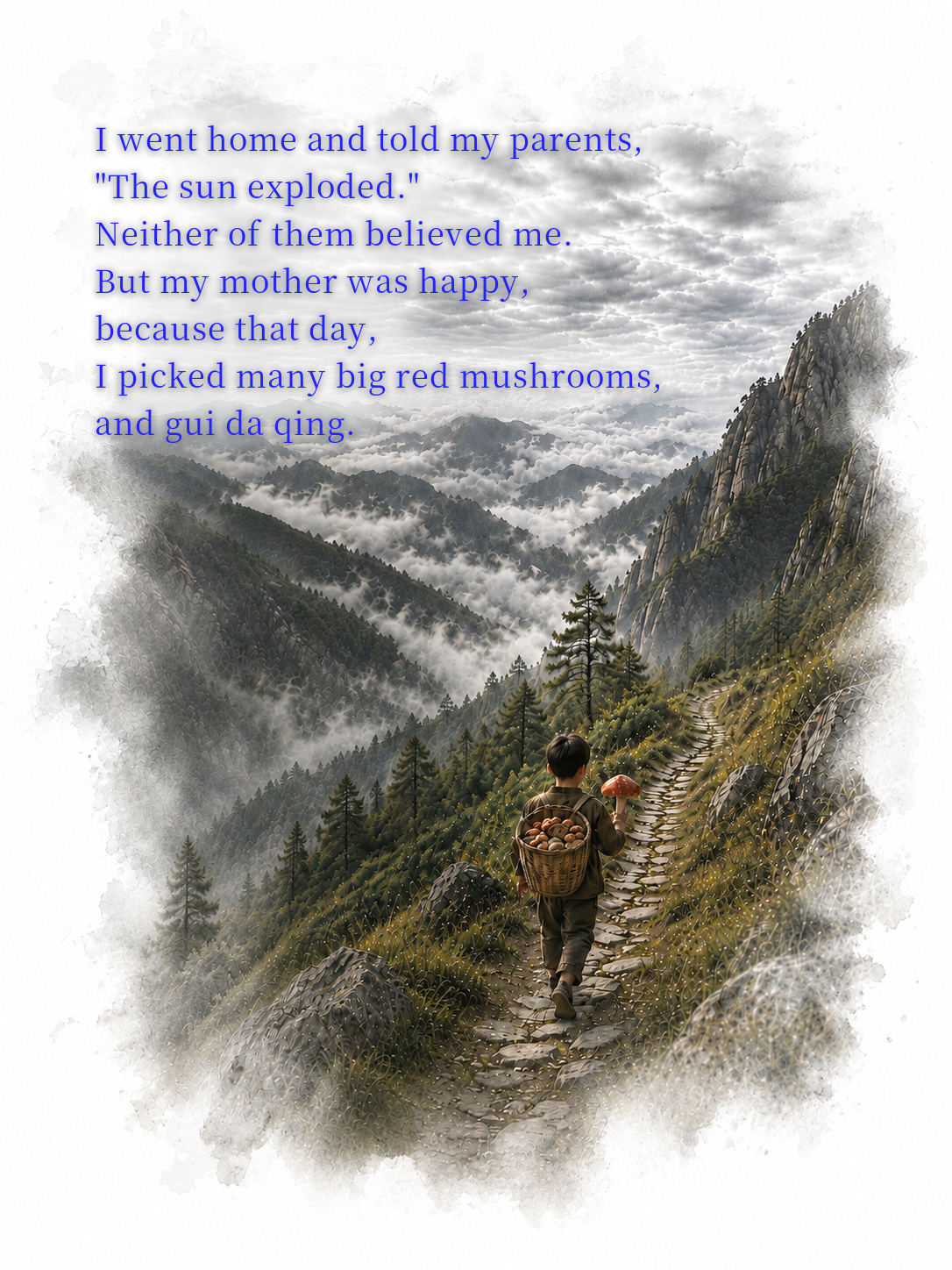
I went home and told my parents,
"The sun exploded."
Neither of them believed me.
But my mother was happy,
because that day, I picked many big red mushrooms,
and gui da qing—mushrooms that turn blue at a touch.2
Later I started school—
first at the He Family Ancestral Hall,
then at Heping Commune.
The school handed out textbooks.
When I wanted to read,
I carried books to the mountain's summit,
found a flat stone to sit on.
That feeling was nothing like the classroom.
I read until I was tired,
then watched the sea of clouds in the distance.
Mushroom hunting and school sometimes clashed.
Once on the way to school,
I spotted a bowl-sized mushroom,
purple,
growing on the edge of a cliff.
It took a lot of effort to pick it.
I ended up being late for school.
Our Chinese teacher made the late students
line up in a row in front of the podium,
kneeling on brooms.
A few of us knelt there,
giggling and carrying on,
thinking nothing of it.
Later a girl surnamed Zhou told me,
something big happened—
my mother happened to pass by the school that day,
stood outside the classroom's back window,
watched us for a long time,
then told the commune leaders.
Because of this,
the teacher's promotion to vice principal
fell through.
I was surprised,
didn't dare ask my mother,
and just felt uneasy.
I often went to the neighbors' houses
to play with the other children,
comparing tree-climbing tricks.
Sometimes we went together into the mountains
to gather firewood
or pick wild fruit.
I could climb very high
and bring back loads of firewood.
For wild fruit, height didn't matter—
only sharp eyes
and a keen nose.
Some wild fruit smelled so sweet
you could catch the scent from far away.
When it was time to eat,
my parents would call my name across the valley.
The echo lingered for a long time.
When I heard them,
I ran back.
The mountain paths were narrow
and I ran as fast as I could.
Every little stone,
the way it lay,
I knew by heart.
Birds flew overhead—
sparrows and bulbuls.
The clouds lay at my feet,
stretching out of sight.
Back then,
I didn't know what lay beyond the horizon.
I never thought to ask.
The world was only what was before me—
the slope behind the house,
the ditch in front of the house,
the fields at the foot of the mountain,
the school a little farther out,
and the spring that had always been there.
Water came out of a crack in the mountain.
They said it had never run dry in hundreds of years.
In our local dialect,
the spring was called Yangmimi—
which means "Dragonfly Spring."
People piped the water home through lengths of bamboo.
We had it too.
It ran to the stove and into the water jar.
When thirsty,
I bent down and drank.
Cool,
with the mineral tang of stone and moss.
I still remember that taste clearly.
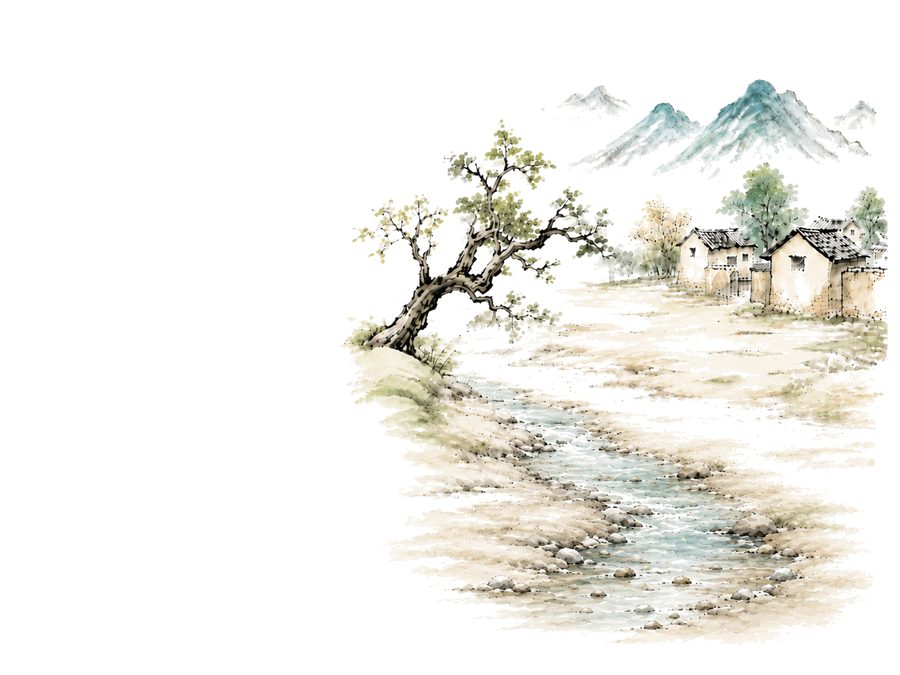
On the cliff above the spring stood a few wild jujube trees.
Below,
a small stream.
The jujubes fell into the water.
I would pick them up and eat them—
they weren't sour at all,
they were sweet.
When there were no jujubes,
I would squat by the stream and turn over the stones.
Underneath, crabs sometimes hid.
The big ones were strong
and would pinch.
I only searched for the small ones,
caught them,
held them in my palm
and watched them scuttle sideways.
I never ate them.
I played with them for a short while and put them back.
The water was so clear you could see the bottom.
For hundreds of years,
the water had never stopped—
nor had the crabs.
Where the stream flowed onward,
there was a large rock.
Not an ordinary rock—
limestone.
Pale, with a bluish tint, layer upon layer,
like pages standing in a row.
The elders said the rock had not fallen from the mountain.
It had been formed by water—
drop by drop, over countless years.
I often went there to sit,
feet in the water,
back against the rock.
The sun warmed the stone.
The water flowing over my feet was cool.
I sat there and listened.
The water flowed quietly.
Mud
When I was little,
I loved playing with mud.
There were many ways to play with mud.
My land was a paddy field.
When it was time to plant rice
I would go looking for soft mud.
I spread my toes and stepped in.
The mud slipped between them,
rose through the gaps,
then slowly sank back.
A little cool.
A little ticklish.
Sometimes something moved underfoot—
a loach, or a swamp eel.
I would bend down to catch it.
Sometimes my hand slipped,
it would quickly wiggle back into the mud.
The slower ones—I'd catch and bring home.
That night, they would end up on the dinner table.
My grandpa lived at the foot of the mountain,
together with my youngest uncle.
My oldest uncle and my aunt lived down there too,
though farther away.
I often went down to play with my cousins.
Sometimes hide-and-seek.
Sometimes looking inside bird nests.
At the bend into the village
there was a clay bodhisattva.
A red cloth hung over it.
Oranges were placed below.
When nobody was around,
I peeled one orange and ate it.
Very sour.
One leg of the clay bodhisattva was missing.
The face was hard to make out.
I went home and found some mud,
and tried to mold a bodhisattva myself.
I worked at it for a long time
and realized it was not that simple.
Mud came in many kinds.
Some was too dry—
it cracked when I squeezed it.
Some was too sandy—
never held together no matter how I pressed it.
But below the slope there was one patch of mud that was different.
The mud there was fine,
very soft.
With a little kneading it came together into a ball.
The first time I touched that kind of mud was on a summer afternoon.
The sun was strong
and the grass on the hill began to yellow.
I ran wild on the hillside by myself,
my feet sinking into the loose soil.
Then I noticed a small patch of mud unlike the rest.
I grabbed a handful.
It was fine—
like flour.
I carried it home,
sat on the doorstep and slowly shaped it.
Many years later, I still remember how it felt in my hands.
Soft.
Cool.
Slowly yielding, slowly changing shape.
I did not know then
that there was a word for it—sculpture.
I only felt that turning mud into a shape was something magical.
Our house was built of earth.
The walls were thick.
There were cracks on the surface, some deep, some shallow.
Spiders sometimes lived inside,
and would come out to spin webs.
When my cousin from the city came,
she could not sleep at night.
She said she was afraid of the cracks on the walls.
I found that hard to understand.
They didn't bite.
The surface of the walls was a little rough.
One day,
I don't know why—
I suddenly wanted to leave something on them.
At first, I only traced a few lines with my finger.
Later, slowly, I began to scratch shapes into it.
A nose.
Eyes.
Ears.
A faint face emerged on the surface.
No one taught me.
It was pure fun.
Sometimes,
I carved characters into the wall as well—
with a branch, or a nail.
I wrote my name,
or characters I learned in school.
When I finished,
I would step back and look for a while.
Some were crooked, but I liked them.
Behind our house, off to one side,
there was a cliff, one solid face of stone.
There was a hole in it.
We called it Barbarian Cave.3
I could crawl inside.
Inside was another little world:
stone tables, stone chairs and stone beds.
Everything was there.
My mother said people from long ago carved it out by hand.
After that,
I took a small knife and started carving into the earthen wall at home.
On the corner of the main room
I carved out a nose.
Just as I was about to carve the eyes,
my father found me.
I nearly got a beating.
He said if I kept carving,
the house would collapse.
Around the house
my mother planted a few camphor trees.
She said that when I grew up and had a family of my own,
those trees could be made into furniture.
When I was old,
they might even be used for the coffin.
Later, I often carved characters into their bark with a small knife.
As soon as the blade cut in,
sap would slowly seep out,
cool, with a faint fragrance.
My mother said that scent kept insects away.
Once, I carved the three characters for "Shaolin Temple."1
Very neatly—
like in the opening title of the movie.
I was happy for days.
Stone
Below Dragonfly Spring
there was more than just that one large rock.
There were many smaller ones in the water as well—
white,
worn smooth and round by the current.
Once, I picked up a stone marked with ring after ring.
I was certain it must be a fossil.
I ran all the way home with it,
burst into the yard
and said to my father,
"I found a fossil!"
My father was playing mahjong with friends.
They glanced at it and laughed.
Someone said,
"If it were really a fossil, your family would be rich."
My father weighed it in his hand and said, "It's just limestone."
"Throw it away."
I felt a little angry.
But I didn't throw it away.
I kept it.
To me, that stone was more precious than any fossil.
Then the road reached the village.
A road was a good thing—
everyone said so.
With the road, it became easier to reach the town,
and goods could be brought in.
What we didn't know was that with the road,
things could also be taken away.
One night,
someone drove into the village.
We were already asleep.
The next morning
the limestone rock by the stream was gone.
Such a large rock—
gone.
Only a pit remained,
with tire tracks and the smell of gasoline.
Who took it?
No one knew.
Where did it go?
No one knew either.
People talked about it for a few days,
then let it go.
A rock was just a rock.
Gone was gone.
Much later,
someone who had been to the city returned and said
he saw a rock in a courtyard there—
pale, with a bluish tint, layer upon layer, like standing pages.
He said it was the one from our stream.
Our rock became someone else's garden stone.
That night, I had a dream.
The stream had no water.
The crabs were gone.
The earthen walls were cracked through,
falling away at a touch.
I woke with an emptiness in my chest.
It felt as if my mother had been stolen.
The mountain, the water, that rock—
and everything that had been there for hundreds of years.
They had been there.
And then one day,
they were no longer ours.
The mountain is still there.
The spring still runs,
the crabs still live in the stream,
the earthen walls still stand.
But something is no longer the same.
That was the first time I understood
that the world was larger than the village.
And that the world would reach in
and take what it wanted.
-
Shaolin Temple (少林寺; Shaolin Si), located on Mount Song near Dengfeng, Henan—one of the cradles of Chan Buddhism, renowned for its association with martial arts and popularized worldwide through films such as Shaolin Temple (1982). ↩
-
gui da qing (鬼打青): a southwestern Chinese folk name for wild boletes; often prized in Yunnan and Sichuan cuisine. ↩
-
Barbarian Cave (蛮子洞) is a folk name in Sichuan for ancient caves hewn into cliff faces or hillsides. Legend has it they were once dwellings of the manzi—"barbarians"—of old. ↩